
Evaporator Coils: How to Identify and When to Replace
An evaporator coil sits inside, gets cold, and drips. A condenser coil sits outside, gets hot, and does not. If you are standing at a unit trying to work out which one you are looking at, that is the whole test. Everything below is about deciding whether the coil is worth replacing, and what you need to know before ordering one.
“Evaporators” is the most-searched term on servair.com. This is the guide behind it.
Evaporator or condenser? Telling them apart
| Evaporator coil | Condenser coil | |
|---|---|---|
| Where | Indoor unit / air handler | Outdoor unit |
| Job | Absorbs heat from room air | Rejects heat to outside air |
| Surface temp | Cold, typically below dew point | Hot |
| Condensate | Yes — it has a drain pan and line | None |
| Fails from | Formicary corrosion, mould, blocked drains | Salt corrosion, impact, fin damage |
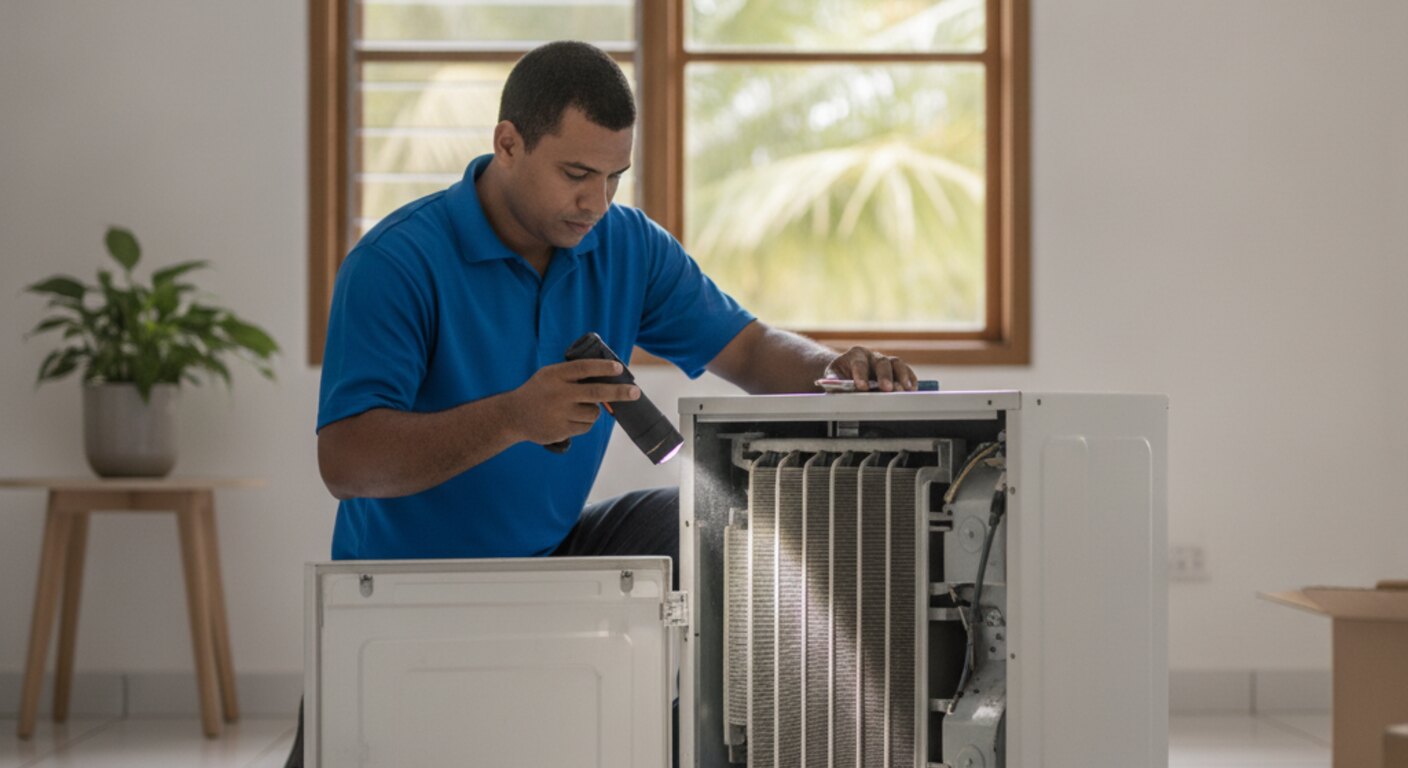
In a Trinidad split system the evaporator is the finned block behind the indoor unit's filters. In a window or portable unit, both coils are in the same box — the evaporator is the one facing the room.
The five failure modes, and which are worth fixing
| Symptom | Likely cause | Repair or replace? |
|---|---|---|
| Slow refrigerant loss, no visible damage | Formicary (pinhole) corrosion | Replace. Pinholes come in populations, not singles |
| Single accessible leak at a joint | Vibration or a bad braze | Repair is reasonable |
| Ice-up, poor airflow | Dirt loading, blocked filter, low charge | Clean and diagnose — the coil is usually fine |
| Water indoors | Blocked drain or pan, not the coil | Clear the drain |
| Crushed or heavily bent fins | Impact | Comb if light; replace if tubes are deformed |
Formicary corrosion is the one that matters here. It produces microscopic pinholes through the tube wall, driven by organic acids in indoor air — cleaning products, adhesives, new furnishings. It is invisible without a proper leak hunt, it does not appear in one spot, and a coil that has it will keep leaking after each patch. When a coil loses charge repeatedly with nothing to see, stop repairing it.
What you need before ordering a coil
- Unit model and serial. Coils are model-specific — circuiting, slab dimensions and connection positions all vary.
- Refrigerant type. A coil is matched to the system's refrigerant and metering device; see Refrigerants.
- Connection sizes and orientation — measure, do not assume from the old invoice.
- Metering device — capillary, TXV or EEV. Some coils ship with it, some do not.
- Photographs of the coil in place, showing the connections and the drain pan.
What Servair stocks
Coils live in Coils & Heat Exchangers — coil assemblies across Carrier, Gree and Coldwave, including microchannel (MCHX) condenser coils. Related parts sit in Refrigerant Line Components and Valves.
If a coil is being replaced because of a leak, price the line components at the same time. A coil change is the cheapest opportunity you will get to replace a filter drier and a tired service valve.
Before you condemn the coil
- Confirm the leak. Electronic detector, then bubbles or dye to localise it — see Parts for detection consumables.
- Weigh the recovered charge. A system that is barely down is not necessarily leaking through the coil.
- Check the drain first on any water complaint. Most “coil” call-outs in Trinidad are blocked condensate lines.
- Look at the air side. A coil buried in dirt behaves exactly like a failed one and costs nothing to clean.
Need help matching a coil to a unit? Send the nameplate and a photograph of the coil to 1 (868) 658-1911 on WhatsApp, or call 1 (868) 658-1910.
Frequently Asked Questions
Can a leaking evaporator coil be repaired instead of replaced?
It depends on the leak. A single leak at an accessible joint, caused by vibration or a poor braze, is a fair repair. Pinhole leaks from formicary corrosion are not — they occur in populations across the tube surface, so patching one simply moves the problem. The practical test is history: if the system has been topped up more than once with nothing visible to find, the coil is the problem and repairing it again will not hold.
Why do evaporator coils corrode faster in Trinidad?
Two things stack. Indoor humidity keeps the coil wet for most of its running time, and wet surfaces are where corrosion chemistry happens. Coastal air adds salt to the outdoor side. Formicary corrosion specifically is driven by organic acids from ordinary indoor sources — cleaning products, solvents, new furniture — concentrated in the condensate film on a cold coil.
Do I need to change the refrigerant when I change a coil?
You are not changing refrigerant type, but you are not reusing the charge either. Recover it, replace the filter drier, evacuate the system properly and weigh in a fresh charge to the manufacturer's figure. Reusing recovered refrigerant after a coil failure risks carrying contamination and moisture into the new coil, which is how a second failure starts.
You may also like